
~51 minute read
I. Nobody’s Perfect, a Long Preamble
There is a part of the human nervous system, the recurrent laryngeal nerve, which controls the muscles of speech. Although the brain and the larynx are only inches apart, this nerve travels down from our brainstem, past the larynx, loops around the enormous aortic vessel that carries blood from the heart, and then climbs all the way back up again to its original intended destination.
In short, it takes a lengthy detour.
If you stop for a moment and listen carefully you might be able to hear a voice far off in the distance, perhaps it’s a management consultant or a systems engineer. They’re screaming: “Imagine the efficiencies we could save if human beings had control over their own design!” If they had their way, abnormalities like the wasteful detour taken by the laryngeal nerve would be removed and our bodies optimised. But there is no blueprint or design process. Humanity is the result of evolution, ad hoc and improvised. The laryngeal nerve is evidence of this. Hundreds of millions of years ago, long down the evolutionary chain, back when we were fish, this nerve took a more straightforward route; it linked the brain to the gills by threading through the aortic blood vessels around the heart, which was nearby. But as fish became mammals, necks grew longer and hearts sank into chests. The nerve, still threaded through those blood vessels, was dragged down with them. And so what was once a short, direct path became a great loop flattened and stretched out between our heads and our hearts. We share this same engineering oversight with many other animals, from giraffes to velociraptors. Each one an accumulation of good ideas and debris.
As the saying goes, nobody’s perfect. But what if there were a way to change human biology? Would you get rid of the laryngeal nerve’s detour? And if so, would you stop there? Could you be more productive? Happier? Healthier? Sexier? There are numerous tweaks you could make that would improve something or other. It would be hard to resist, because there’s a management consultant somewhere inside us all, as sad as I am to say. Modern society demands it. It demands optimisation because today is the first day of the rest of your life. Do what you love, love what you do. Be your best self, find your why, rise and grind. Hustle hard, and slay, slay, slay.
In 1930, the economist John Maynard Keynes wrote an essay titled Economic Possibilities for our Grandchildren in which he predicts that:
[T]he standard of life in progressive countries one hundred years hence will be between four and eight times as high as it is to-day. [...] Thus for the first time since his creation man will be faced with his real, his permanent problem—how to occupy the leisure which science and compound interest will have won for him.
In only a few years a century will have passed since Keynes' prediction and it now reads like comedy. Not only have we failed to create a utopian state, but the economic situation for most of us is getting worse. Research by the London School of Economics found that whilst productivity had grown by 87% between 1981 and 2019, the median wage had only increased by 62%2. Put bluntly, we are working more productively than ever but we’re not being paid for it. In spite of the incredible technological leaps of the last century, we are no closer to being free from work. What are the economic possibilities for our grandchildren?
I doubt your answers will share Keynes' optimism. In fact, I suspect you might be pessimistic about their chances. This feeling of dread is pervasive in Britain at the moment. The landscape of our politics is defined by it, we are stuck in a slow descent that we are acutely aware of. With both productivity and inequality on the rise, is our obsession with patterns and order driving us to optimise how we work at our own expense? And if so, why don’t we do something about it?
Mark Fisher named our condition as capitalist realism. We have been made to believe that there is no way to live other than the one that has been thrust upon us. There is no alternative because alternatives have been made unthinkable. The economic system doesn’t need to justify itself, or even be justifiable. It simply dominates so completely that when we work more and earn less, we treat it as an immutable fact akin to a natural law. The only way to get further, or even to stay still, is to trade our time, our health, and our values for a higher wage. On a wider scale this breeds a competitive individualism that operates on a Darwinian logic: optimise or die.
Although many philosophers agree that we live in such a society, their articulation of how it is structured varies greatly. Michel Foucault developed the concept of panopticism, based on a prison system designed by Jeremy Bentham where a guard sits hidden in the shadows of a dark watchtower surrounded by cells. Unlike the tower, every cell is illuminated and orientated such that each inmate “is seen, but he does not see; he is the object of information, never a subject in communication.” Modern examples of the panopticon exist but are not so straightforward, for instance corporations track us invisibly through the data produced by the technology we use every day. Like the inmates we are individualised and objectified through this process.
More recently, South Korean-German philosopher Byung-Chul Han described our individualism as a symptom of the way we live, which has become an achievement society3. He argues that we are obsessed with self-improvement at all costs. Self-improvement requires self-measurement, and self-measurement requires a standard — something to compare yourself against. The standard that achievement society offers us is not who you are today, but who you could be. The best version of you.
Both Foucault and Han are describing a system in which we are made into subjects to be measured, quantified, and controlled.
Quantum mechanics tells us that if an atom is separated from the outside world — for instance, if it is sealed within a supercooled vacuum chamber — it can exist in a superposition of different states, even contradictory ones. This is purely quantum behaviour that has no counterpart in the physics of everyday life. And the moment we measure it we damage it. This phenomenon is known as the observer effect, and it is often mistaken for a mystical sign that consciousness affects reality on some deep level. It does not. What it demonstrates is that the mere act of measurement is an intrusion which contaminates the atom’s quantum state with the disorder of the outside world. Quantum physics seems strange and rare because it is fragile. It cannot survive contact with the messy physics of the everyday. So when we open the vacuum chamber to look inside the result is catastrophic. Before we can even see anything, the atom has been reduced to a single definite state governed by the more mundane logic of the everyday, one among many.
Human beings share the fragile vibrance of the cold atom. Despite our love of order, we hold many contradictory ideas and impulses within ourselves. These illogical things are the source of our best and worst qualities. When they are revealed to the world, like a state of superposition, they are at risk of being destroyed. This is why, consciously or not, through faith and ignorance, we protect them from reason.
I’m not using this analogy just because I’m a physicist, I want to show you that modern society is dominated by scientific ways of thinking that appeal, crucially, to our nature as categorisation machines. By making measurements we can quantify the world, uncover its patterns, and deepen our understanding of it. But not every measurement is benign, they can disrupt the inner life of their subject. And because every measurement requires a standard, whoever is performing a measurement can use it to define the outcome before it’s even been produced.
This is a trap. Standards can be completely hypothetical and in achievement society nothing is impossible, even perfection. This is never clearer than when we are implicitly told through advertising to spend like a millionaire, work out like an athlete, and look like a supermodel. They are hallucinations presented as reality, constructed in isolation from what life actually looks like, then projected back on real people as the thing we must be. And they motivate by reducing us. Even if the best version of you existed, it would be a single person with no dimension or difference. Fully optimised and colourless. That is not what you are. You are not a lone atom in one definite state.
So what do we do about this increasingly “measured” society? It’s not like I, having written all of this, live anything that resembles an unmeasured life. Far from it! I use social media in which I am knowingly monitored, I keep track of my fitness with a smart watch, and I monitor the health of my plants with a soil sensor. I have turned the tools of science onto my own life in an attempt to quantify and control it. But I also know that with each measurement performed, bit by bit, a little piece is taken from me. I think this is a bargain we all unconsciously make, and I want to better understand what I’m paying.
A century ago, a playwright imagined the logical endpoint of this process. It is a cautionary tale about an optimised human being, engineered like a machine, with an insatiable yet egoless drive to achieve.
The ultimate subject of science, and the first robot.
II. A Night at St Martin’s
In a previous article, I addressed some of my concerns regarding the future of robotics by exploring its origins. In doing so, I encountered George the Robot. George was a grotesque facsimile of humanity whose strange metal body married science with art. Despite how frankly terrifying this machine appeared, it appealed to the imagination of those who saw it. The creators of George presented the British public with a fairytale future in which mechanical servants perform menial labour whilst they enjoy a life liberated from work. George was technologically advanced for his time, equipped with early electronics and radio technology. But what really caught my attention were the photos. In them I could see the initials “R.U.R.” brightly emblazoned on the robot’s chest, which I thought was strange. Stranger still was my discovery that this was the name of a Czechoslovakian play.
Domin: Young Rossum invented a worker with the minimum amount of requirements. He had to simplify him. He rejected everything that did not contribute directly to the progress of work. Everything that makes man more expensive. In fact he rejected man and made the Robot. My dear Miss Glory, the Robots are not people. Mechanically they are more perfect than we are; they have an enormously developed intelligence, but they have no soul.
Helena: How do you know they have no soul?
Domin: Have you ever seen what a Robot looks like inside?
Helena: No.
Domin: Very neat, very simple. Really a beautiful piece of work. Not much in it, but everything in flawless order. The product of an engineer is technically at a higher pitch of perfection than a product of Nature.
Helena: But man is supposed to be the product of God.
Domin: All the worse. God hasn't the slightest notion of modern engineering.
Written by Karel Čapek in 1920, R.U.R. introduced the world to robots, but not the type you’re familiar with4. These are flesh and blood like us, but without any “engineering mistakes.” Čapek’s robots are superior in every way but one: they are members of the lowest class. And so they must serve us unfeelingly. Mechanically. Perfectly. Čapek initially intended to name his race of servants “labori,” until his brother Josef suggested “roboti,” a word derived from an Old Czech word; “robota,” which describes the type of work enslaved peasants were forced to do by feudal lords in medieval times. The play then found its full title: Rossumovi Univerzální Roboti, the English translation of which is Rossum’s Universal Robots.
It became a genuine international sensation, seen by hundreds of thousands of people across the world from London to Tokyo. This almost seems implausible given how relatively unknown it now is in the English-speaking world. Although the play itself has long left public consciousness, the shape it cast remains everywhere in contemporary imagination. Most impactful is the word ‘robot,’ which eclipses any cultural impact the play has had and now describes things that Čapek wouldn’t recognise or understand. What struck me most about R.U.R. is that Čapek’s original robots feel as if they were created with modern society in mind. With this in mind, how and why did these engineered humans transform into simple machines in the public consciousness?
We can only answer that by going back to the original performances. The play as it was: A living thing shaped by producers, performers, set designers, directors, and their audience. If we recreate those early experiences of the play, we might capture a sliver of its essence. It’s impossible for me to do this without the modern world seeping through, but perhaps that’s the point. Han’s achievement society, the neurotic world of self-exploitation, didn’t exist when Čapek was writing. And yet his robots feel like the final evolution of his image of humanity, “an animal laborans that exploits itself — and it does so voluntarily, without external constraints”. Perhaps there is something inside this play that you and I can take from it that our ancestors couldn’t.
Act I. Creation
It’s a summer night in London, 1923. On the recommendation of your neighbour, you’ve come to experience the hit show R.U.R. at St Martin’s theatre. Yellow sodium suffused with red velvet, the light in this place glows like a bright ember. Although you came early enough to get a good seat, your view of the stage is somewhat obscured by a pair of mismatched men puffing out a dense trail of tobacco smoke. Against your will you overhear them have an excruciatingly detailed conversation about the Chinese legal system and recent goings-on at a law firm called Stephenson Harwood & Tatham. Sadly, just as the topic of conversation shifts on to more interesting things, namely the apparently-obvious affair that their manager is having with his secretary, that ember-light dims and the play begins.
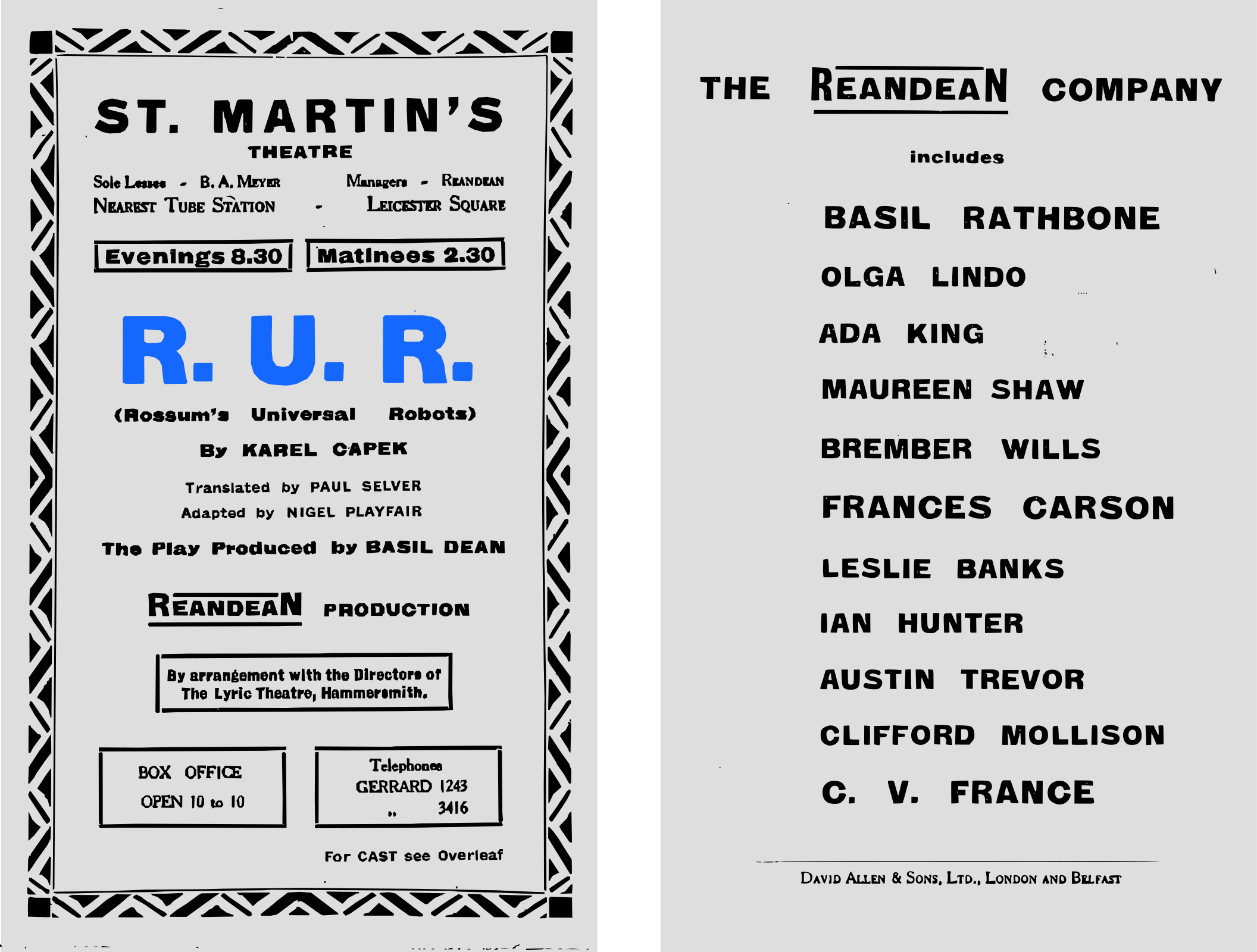
The curtain rises on a factory office. Through its tall windows you can see chimneys, telegraph poles, and endless rows of factory buildings. On the office walls are maps of steamship and railroad routes, printed placards that say things like “Robots Cheapest Labour,” and bookshelves filled with bottles of wine. A well-dressed man is sitting at an enormous desk — this is Domin, played by Basil Rathbone — an actor and a war hero! He’s dictating a letter to his secretary, Sulla: a dispute about damaged freight, robots spoiled in transit aboard an unsuitable vessel. He moves briskly through the correspondence: five thousand robots to New York, fifteen thousand to Hamburg, coal to be credited as part payment. Then a young woman arrives, she speaks in a distinctly American accent, and you realise this must be Frances Carson, playing Helena Glory.
You can tell from the moment you saw him that Domin is a cad. With a clear desire to charm her, he tells Helena the story of how the robots came to be. On a distant island the elder Rossum, a great scientist, discovered a substance that behaved exactly like living matter. He tried to build a man but each attempt led to a creature that lived but a few days. His nephew, an engineer, watched the old man fumble for years and declared it absurd. Young Rossum applied his skills to improve the creature’s design. He rejected everything that did not contribute directly to the progress of work. A working machine must not feel happy and so it need not smile. And then, at last, he created the robot. Domin then reveals that Sulla, who has been quietly sitting at her typewriter from the very start, is a robot!
Whilst they talk, you watch Sulla. So this is one of the so-called “robots” that the newspapers keep raving about… She looks human, although there is certainly something queer about her. How she looks, moves, and speaks, it’s all abrupt, rigid, and measured. It is as if she were an exquisite clockwork device, and sat on top of it all is an expression completely devoid of emotion. She makes you feel sad. You are reminded of Frankenstein’s Monster. That too was a kind of automaton, albeit made from scavenged skin and bone. A wretched product of science. Unsure of its being and desperate for love. You think of the dreadful revenge that creature wrought on its master.
Your attention turns back to Domin, who is attempting to demonstrate his power to Helena by ordering Sulla to be dissected in front of her. “Marius, take Sulla into the dissecting room, and tell them to open her up at once.” To Helena’s horror, Sulla immediately submits to his wishes. A factory whistle shrieks and she flinches. More men like Domin walk in. Fabry, Hallemeier, Busman, Dr Gall, and Alquist, head of the Building Department. Helena turns to them and speaks with sudden passion, addressing them as if they are robots. She pleads for their freedom, their dignity, their rights. The moment you see one of them raise their eyebrows and smile you know that they aren’t like Sulla. These are men pure and simple. Very simple. Upon realising her mistake, Helena’s pleading turns to frustration as she demands that these men, the managers of R.U.R., take responsibility and treat their robots with kindness. All but one scoff.
Domin: In ten years Rossum’s Universal Robots will produce so much corn, so much cloth, so much everything that things will be practically without price. There will be no poverty. All work will be done by living machines. Everybody will be free from worry and liberated from the degradation of labour. Everybody will live only to perfect himself.
Helena: Will he?
Domin: Of course. It’s bound to happen. Then the servitude of man to man and the enslavement of man to matter will cease. Nobody will get bread at the cost of life and hatred. The Robots will wash the feet of the beggar and prepare a bed for him in his house.
Alquist: Domin, Domin, what you say sounds too much like Paradise. There was something good in service and something great in humility. There was some kind of virtue in toil and weariness.
You return to the stage where Hallemeier, the so-called Head of Psychology, is telling Helena that these robots have no free will. Robots never smile, he says. They don’t feel happiness because they don’t need to. In fact, they feel almost nothing except pain. Dr Gall joins Hallemeier, explaining that the original robots had no sense of it and, as a result, would let their limbs be crushed by the factory machinery. So pain was added, not out of compassion, but as a safeguard. Robots do, however, experience one thing that is outside of their control. It begins as a kind of cramp which then develops, for reasons none of the great minds at R.U.R. are able to discern, into madness. They go haywire and do nothing but stand still whilst gnashing their teeth. These malfunctioning robots are then restrained and taken back to a factory where they are destroyed.
Helena is rightfully shocked. Domin and the other managers attempt to justify themselves by explaining the philosophy behind the robots. These synthetic humans, whose livers are produced in vats, will liberate humanity from work. A woman nearby audibly scoffs and whispers something to her partner. By the end of the act, it seems to you that every man on the island has become completely enamoured with good Helena, and each has asked for her hand in marriage. And to Domin she says yes, it’s the fastest and most absurd courtship you’ve seen on stage to date. These people are fools…
Act II. Revolution
The curtain falls and the house lights come up. You blink for what feels like the first time in hours, you’re frankly discombobulated. Robots! What a fantastic imagination Mr Čapek must have and what a strange place Czechoslovakia must be to have inspired him to create them! You pull yourself to your feet, walk to the aisle and towards the bar. A group of young men ahead are loudly debating whether these “robots” could really exist. One is fully behind the idea, claiming that he’s already seen an honest-to-God robot. In fact, he saw it just a minute’s walk from here in Tottenham Court Road. It was a metal man, he says, built in the likeness of the Kaiser, and it walked and moved on its own. No wires, no strings. He claims that it was much like the robots in the play, a servant of man. In this case it was a man named Captain Roberts who sent the machine orders using nothing but beams of light. The others are incredulous, but he remains absolutely adamant. “Poppycock!” they shout. Blushing with embarrassment, he weakly repeats that he saw it with his own eyes. What an absurd story! You buy a drink at the bar and return to your seat.
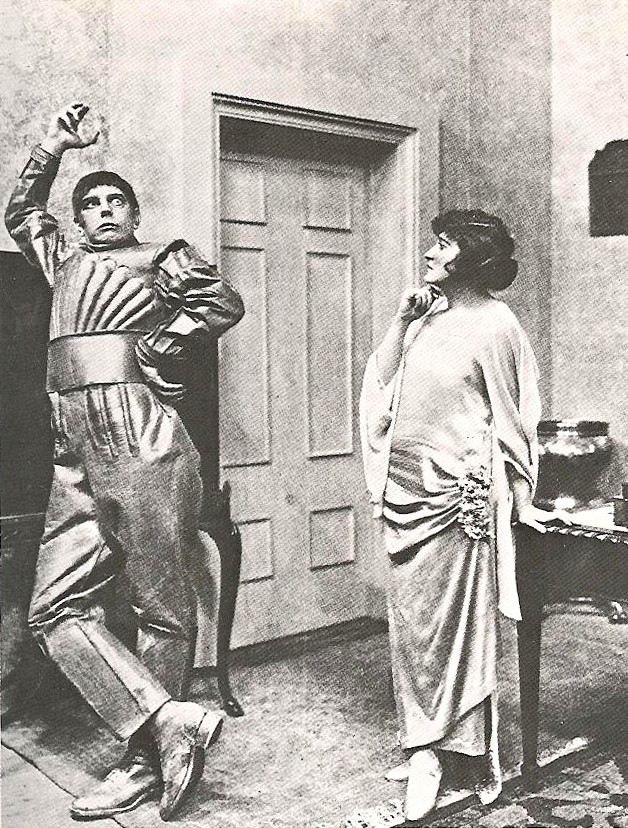
Helena questions Radius. R.U.R., St Martin's Theatre, London, 1923.
The audience settles as the lights dim once more and a decade passes. When the curtain parts you see a space far more pleasant than the factory office; a drawing room filled with silks and sunlight, and a balcony that overlooks a harbour. You do notice, though, that the windows are framed by steel shutters. A gaggle of managers enters the scene, bringing gifts to Helena. Plants and pearls and even a boat! There’s a nervousness about them, and something they’re trying to not mention. At least not in front of Helena. The act unfolds and it becomes clear that Domin’s paradise has not come to pass. Something else has happened in these last ten years. Every day fewer children have been born into the world, and now there are none. And across this sterile world, the gnashing madness has spread through vast swathes of robots like a rabid plague. The infected no longer stand still, they are seemingly propelled by anger to overthrow their masters. But this is a distant island, and these rebellions have not yet reached its shores.
Helena calls for one of the robots, called Radius, who recently fell to this madness. The robot arrives bound. He is wearing a strange set of overalls, a gleaming silver jumpsuit. You’ve never seen anything like it. He looks ridiculous, and unsettling, and strange, and new. Wild-eyed and contorted as if he were in excruciating pain, Radius declares that he no longer wishes to have a master. He wants to be one! The building panic at last washes from the stage over the audience, some of whom gasp. She pleads with him. Helena herself had chosen this robot, raised him, encouraged him to learn and grow. She wanted to prove that robots could be our equals. What would Mary Shelley make, you wonder, of Helena creating this monster through love! A scientist, Dr Gall, arrives to examine Radius. Perhaps he can fix this prideful creature; he built him, after all. He interrogates the robot, threatening him with destruction for his insubordination. You notice the pride slip away from Radius and he is sent away. Dr Gall sees it too, saying: “Do you know, I don’t believe the rascal is a Robot at all any longer."
Then a shocking revelation.
This robot plague was no plague at all. Helena and Dr Gall conspired to alter the robots. Helena wanted them to be more like us. So Dr Gall granted them sensation and feeling. And the first thing they felt was terrible rage. Helena burns Rossum’s research in the fireplace, the only record of how to make robots. As she watches the last of the papers go, an orange glow from the fireplace gently illuminates her face and the managers enter in high spirits.
Dr. Gall: The boat's coming in. The regular mail boat, exact to the minute by the timetable. It will dock punctually at eleven-thirty.
Domin: Punctuality is a fine thing, my friends. That's what keeps the world in order. Here's to punctuality! (The men drink.)
Helena: Then—everything—is all right?
Domin: Practically everything. I believe they've cut the cables and seized the radio station. But it doesn't matter if only the timetable holds good.
Hallemeier: If the timetable holds good, human laws hold good. Divine laws hold good, the laws of the universe hold good, everything holds good that ought to hold good. The timetable is more significant than the gospel, more than Homer, more than the whole of Kant. Madame Helena, the timetable is the most perfect product of the human mind.
The mail boat has arrived. Right on schedule, just as expected. Perhaps the rebellions are a fabrication. The factory whistle blows again, and its piercing shriek doesn’t cease. A cold shiver runs through the entirety of your body. You recall the July Crisis. The fragmented and disastrous news reports that came in from the continent. It all seemed distant and disconnected until a telegram arrived and we were at war. The Great War, and hell was brought to Europe. You know what’s about to happen. You know it in your heart, where it sticks like a thorn. There is only one message delivered by the mail boat:
"Robots throughout the world, we command you to kill all mankind. Spare no man. Spare no woman. Save factories, railways, machinery, mines and raw materials. Destroy the rest. Then return to work. Work must not be stopped."Act III. Extinction
You light a cigarette on your way out of the theatre, wanting some air. You can see Tottenham Court Road from here. It’s a warm evening and the street is busy with people going about their lives. A man in a neat suit pauses as he sees you exit.
“How’s the show? I saw it last week, and I’ve had trouble sleeping since!”
“It’s very imaginative,” you reply.
“I don’t know about that. They’re living it in Russia right now, those robots are just like the Bolshevists…” he says, “The whole world has gone mad. I can’t stand to even read about it in the papers anymore.”
A bus shudders along the road, and two women walk by arm in crook laughing, and in a garden or maybe an alleyway a dog barks.
“Bleak as hell,” he says.
“Well, I hope there’s a happy ending,” you reply, stubbing out your cigarette.
He smiles at that.
“Enjoy the next act.”
The bell rings and you head inside.
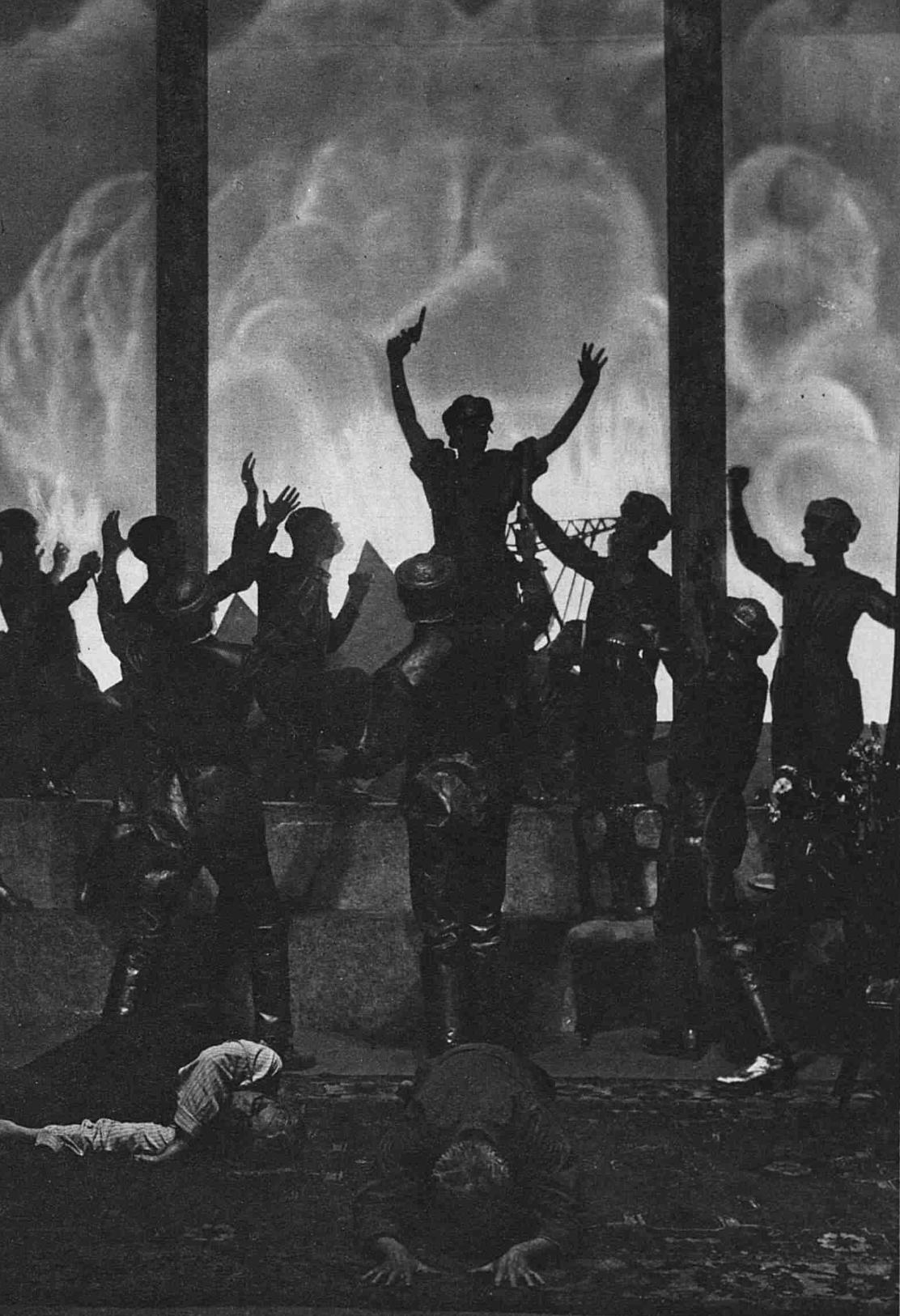
The Robots are victorious. R.U.R., St Martin's Theatre, London, 1923.
The curtains open. The stage is almost dark, a single reading lamp is the only light. It takes you a moment to see it, but you’re in Helena’s drawing room again. The steel shutters are drawn, the room is dark and bare. Somewhere offstage, a piano is playing. Domin and Dr Gall are at the window with their backs turned towards you, straining to see the harbour through the gaps in the metal. The piano stops. You can hear something out there on the other side of the wall. A chorus of voices, rising and falling. Other managers arrive. One of them, Busman, has brought his ledger so as to “wind up the accounts” before the end of everything. One of the law clerks sitting in front of you, the shorter of the two, snorts with laughter and prods his friend. He’s quickly shushed into silence. On stage, the voices change and the men begin to shout at each other. Who’s responsible? What hope is there? What was this all for? They conspire to sell Rossum’s research to the robots. With it, robots will be able to make more robots, and in exchange the managers will have their freedom. They are as they always were, you think, damned profiteers and cowards!
Domin: (From the window) Alquist, this is our last hour. We are already speaking half in the other world. That was not an evil dream to shatter the servitude of labour. The dreadful and humiliating labour that man had to undergo. Work was too hard. Life was too hard. And to overcome that:
Alquist: Was not what the two Rossums dreamed of. Old Rossum only thought of his Godless tricks, and the young one of his milliards. And that's not what your R.U.R. shareholders dream of either. They dream of dividends, and their dividends are the ruin of mankind.
Domin: To Hell with your dividends. Do you suppose I'd have done an hour's work for them? It was for myself that I worked, for my own satisfaction. I wanted man to become the master. So that he shouldn't live merely for the crust of bread. I wanted not a single soul to be broken by other people's machinery. I wanted nothing, nothing, nothing to be left of this appalling social structure. I'm revolted by poverty. I wanted a new generation. I wanted—I thought—
In the madness of it all, Dr Gall and Helena admit their part in changing the robots into human beings. Helena, though, takes the lion’s share of the blame. She says that she knew that Dr Gall would do what she asked him because he, like every man at the company, is in love with her. More than that, she reveals that she has burnt the research. Busman screeches. Wide-eyed and frantic, he grabs bundles of paper money, ledgers, certificates and flees through the door. The others rush to the window to watch him. The fool is out there in the harbour, facing the robots, waving his arms and offering them money for his life. And then he’s dead.
As the cast dejectedly step back from the window, the sound of wind begins. It is low at first, building beneath the voices on stage, until it fills the entire theatre. The people around you shift in their seats. An explosion rocks the stage from outside and the theatre floods with red light. Then another, closer. Domin takes Helena and they leave the stage. The remaining managers pile furniture against the doors. A gunshot rings out from somewhere in the wings. The people around you gasp.
Then at last you see one of the horde, unseen by the rest of the cast, climbing in through the window. He sneaks up on Hallemeier and stabs him in the back! The doors give way and more robots flood in, led by Radius. Each is wearing a silver jumpsuit, and each moves in the same mechanical way. Alquist is dragged in and thrown at their leader’s feet. They ask if they should kill him. “He works with his hands," says Radius. “Leave him." Then Radius himself climbs to the balcony and looks out over the robots, the audience, everybody.
“Robots of the world…"
The robots below turn to face him, bathed in red light, their arms rising slowly into the air and vibrating in terrible ecstasy.
“MARCH!"
Without a word they move into formation. Lines of expressionless robots face you. And then they march. Mechanical and strange. You can hear the rhythm of their footsteps on the boards as they advance. They’re at the footlights at the very front of the stage. There’s almost nothing between them and you. The lights drop to a deep blue and the curtain falls.
Act IV. Epilogue
You come back to yourself after a few minutes, disorientated and wondering how on earth there can be another act. Everyone’s dead.
“What a load of old hooey!” exclaims the woman next to you.
“Come on now, Audrey, I thought parts of it were rather clever,” retorts her husband in a quick and hushed voice.
“If I wanted an evening of exposition, I’d have proposed we have dinner with your uncle.” Her voice untempered.
“Yes, well… He’s hard of hearing and you’re hard of listening.”
The shorter clerk of the two sitting in front of you bursts out laughing and turns to face the couple, leaning over his chair like a schoolboy.
“Sorry to butt in, but I agree with your wife… not that business with your uncle, but the play. It did drag on in places. That being said those robots are quite something, I think there might be a few of them at my office already!”
“I should certainly hope not! They all reminded me of mimes with their costumes, their silence, and their silly haircuts,” she laughs.
“Reminded me of France, actually,” says the taller clerk at last, turning slightly.
The house lights come up.
“Well, I’m getting a stiff drink!” says the husband cheerfully.
“We’re going that way too, so we’ll see you there!” responds the short clerk.
“The more the merrier!” the wife smiles.
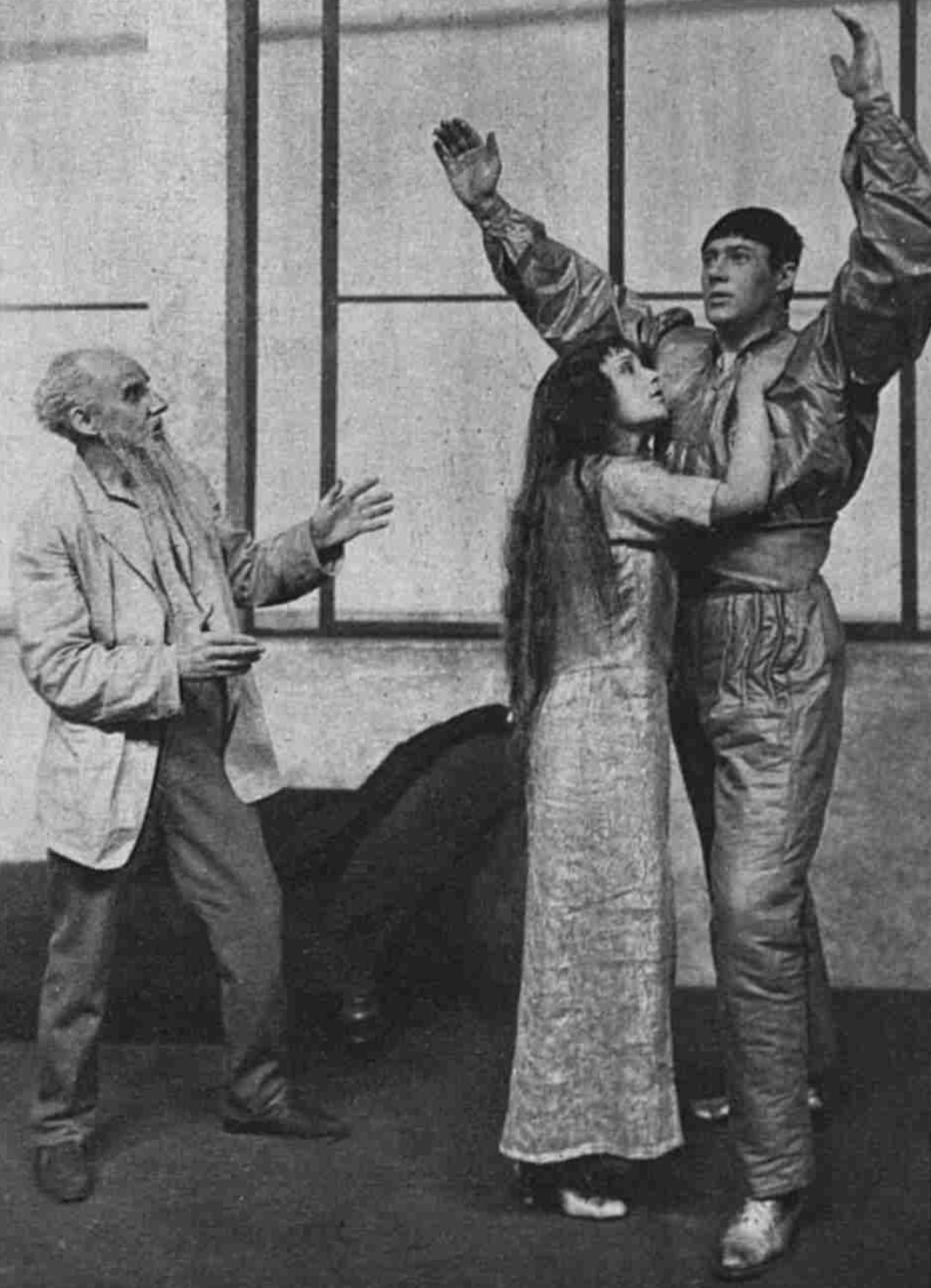
Alquist meets Primus and Helena. R.U.R., St Martin's Theatre, London, 1923.
You stay in your seat for a moment, then get up yourself. You spot a friend on your way towards the bar, and you find yourself being glad of it. You offer to buy them a drink, and they gladly accept.
“What did you make of all that, then?” you ask.
“It’s very political, isn’t it? And, I dare say, a vision of the future.”
“I’m not so sure,” you say, “but I have faith, I think, in humanity.”
“Well, I’m petrified! The Belgians and the French are marching on Germany, again. A maniac’s in charge of Italy. And Russia has gone to the Bolshevists.”
“If we can get through the Great War, we can get through anything.”
“Cheers to that.”
The two of you keep talking until the bell rings, and you head back in together.
The curtain rises one last time, and you see Alquist alone on the stage, his nose buried into a book. The old man is sitting in the same office that Helena walked into all those years and minutes ago, now filled with laboratory equipment. He looks exhausted. Behind him, the shadow of a factory looms across the back wall. He is informed that the leaders of the robots, the so-called Central Committee, have arrived. With Radius at the helm, they tell him that every human being has been destroyed, he is the last. However, the current batch of robots is decaying, without the research that Helena destroyed they cannot reproduce. They demand that the old man rediscover the secrets of Rossum, so they can create more. But despite wishing to, Alquist cannot. Ha! You light a cigarette and breathe it in deeply. A deep catharsis passes through you as the robots rant and rave at Alquist. They march off stage and Alquist, alone once more, collapses onto his desk. The theatre is silent. Not a cough, not a whisper. The couple beside you are leaning in intently, expressionless and expectant. At last, two new figures emerge from the wings, walking hand in hand. Are they robots?
Helena: (Goes to the window) The sun is rising.
Primus: (Reading an old textbook) I believe this is the most important thing in the world, Helena. This is the secret of life.
Helena: Oh, Primus, don't bother with the secret of life. What does it matter to you? Come and look quick.
Primus: (Goes to Helena) What is it?
Helena: See how beautiful the sun is rising. I feel so strange today. It's as if I was in a dream. I feel an aching in my body, in my heart, all over me. Primus, perhaps I'm going to die.
Like you, Alquist sees that there is something different in these two robots. He calls Helena forward, picks up a scalpel, and tells her he’s going to dissect her. You grip the armrest. No! Primus throws himself between them, begging Alquist to take him instead. Alquist turns to the man and puts down his knife. He opens the door. The stage fills with light, amber and rose-pink. It’s a sunrise. Alquist smiles and gestures at the door. “Go. Adam—Eve." The curtain falls. Silence followed by an explosion of applause. Your friend finds you in the crowd and the two of you step out into the night air together.
III. Strange Victory, Strange Defeat
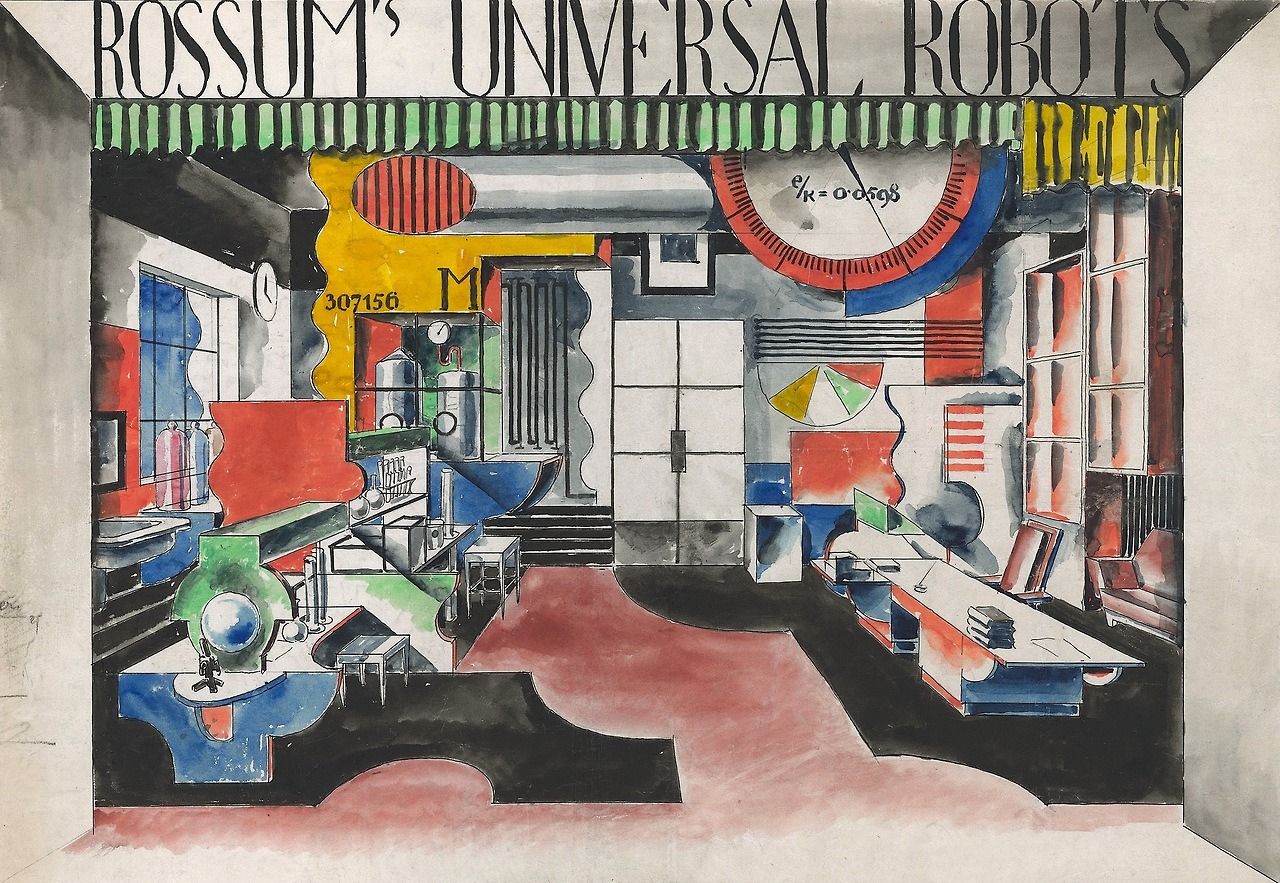
A stage design sketch for R.U.R. by Bedřich Feuerstein, GHMP, 1921.
So there you have it, the origin of the robots. Did they meet your expectations or subvert them? Upon researching R.U.R., reading the script, and picturing the performance, I was struck by the sheer spectacle of it all. Take the climactic scene in Act III when, following their brutal victory, the robots march upon the audience. Imagine the shock as the lights were cut just as they reached the footlights. What did those watching think would happen next? Would robots violently launch themselves into the crowd? Perhaps they would escape the theatre and wreak havoc on London town? Or maybe the robots were already there, sitting beside you in the audience, or at your workplace, or perhaps even in the Houses of Parliament…
For much of the play robots are both everywhere and nowhere. They are said to be in every factory across the globe, but we only see a handful of servants. That is until the penultimate act when the horde crashes onto the stage in spectacular and shocking fashion. I can imagine the gasps and the excitement in the crowd to see such a thing. And for that, for the enduring image of the robot that this play created, the actors, costume designers, and directors deserve as much credit as the play’s author. From their silver outfits, to their rigid movements and abrupt speech, every detail is designed to make the robots feel uncanny and otherworldly.
Some critics at the time disagreed with this approach, take Christopher St. John who, writing in Time and Tide, complains that the robots moved like “cheap mechanical toys” and protests that the play “would be more thrilling if the Robots looked, what they claim to be, the superiors of men in efficiency.” I doubt they would have influenced culture so powerfully had St. John’s instructions been followed. And yet their triumph has a strange shape to it. The robot entered every language, but the play itself slipped from memory. Were robots too successful, did they eclipse the play or succeed in spite of it? In other words, as a work of art, how does R.U.R. stand on its own terms?
To my mind, this is a play that speaks in primary colours. It is not delicate. It is not nuanced. It tells a big story with big emotions, and you pay attention whether you like it or not.
There are moments that feel stale. For instance, a lot of time is spent on world-building, exposition, and ethics. This is something that science fiction would later become famous for, and although it gets a message across, in the case of R.U.R. it doesn’t give the characters much space to breathe. As a result, Helena, Domin, and Alquist all mirror the robots in their depth, or lack thereof. Although this detracts from the story in places, it enhances it in others. Their indifference to the reports of robot madness and human infertility gives the play a fantastic sense of dread. With each fall of the curtain, we feel something horrid and inevitable inching closer. Offstage, behind the shuttered windows, terrors are unfolding and nobody seems to care. That dread is so sustained that when the robots finally come it feels cathartic, simultaneously bringing an end to the world and our anxieties. This is the play’s big moment, and what audiences will remember a day, a week, a year after seeing it. The Illustrated London News called the climax of the robot rebellion “one of the most impressive and harrowing situations our theatre has known."5 Across the pond, in Chicago, audiences sat “breathlessly and in almost sepulchral silence through a play lasting till five minutes past midnight."6
If we look beyond the play and into its historical context then we find that its emotional power is supercharged. R.U.R. marries two critiques, one of technology and one of industrial capitalism, neither of which would have been lost on the audience. This play was written in a decade, like our own, of deep inequality. The mistreatment of the robots and their subsequent rebellion is a straightforward reflection of the international communist movement which had begun in earnest with the Bolshevik Revolution a few years prior to the play’s creation. Furthermore, at the time of its showing at St Martin’s, Britain was still reeling from the horrors of the First World War. Everyone in the audience would have known someone who died in that war, the first to have pitched men against machines. This was a general public viscerally aware that they were living in a dangerous new world shaped by wealth and technology, seemingly without God or morals. In the pages of the Industrial Pioneer, a journal of the Industrial Workers of the World, Rosa Knuuti recognised the play as a portrait of her own working life: “What could be more alluring to our present captains of industry than to obtain a formula whereby an army of standardized, model workers could be manufactured on a large scale, devoid of everything that tends to hinder the making of profits?"6
This desire to speak to the politics of the present is both the play’s great strength and its natural limitation. In The Stage of the Day, theatre critic Dukes compares R.U.R. to a newspaper, which does not attempt to tell a timeless story, as books often do, but instead speaks powerfully today at the cost of being forgotten tomorrow. Dukes writes that the strength of the play “lies even more in its hour than in its subject,” and here he appears to express my own opinion more eloquently than I ever could, and over a century earlier at that:
The play is not a piece of dramatic literature; it is scarcely even a deep or thoughtful work. It is a piece of brilliant journalism of the stage, a work of temperamental power that "carries," as actors say, because the author believes in it, and believes in his audience, and is interested in their reaction to what he has to say. [...] It is certain that our sympathy for the Robots increases as the play proceeds, if only because they are more interesting than the human beings who claim to have made them. Eventually we begin to wonder whether we ourselves may not be Robots. A theatre full of Robots waiting for an awakening.
Not everyone was convinced of the play’s brilliance as either a piece of journalism or dramatic literature. In the New York Times, John Corbin dismissed the play as “a Czecho-Slovak Frankenstein” with a “vague,” “flabby,” and “crassly sentimental” final act.7 Corbin ends the review by questioning the ideological leanings of Čapek, asking if he was “more socialist or nihilist?” 6 The Manchester Guardian wrote that “the bulk and pressure of the tragedy are so potent that the sudden reversion to optimism [in the final act] is disconcerting and ineffective. The suggestion of escape is unworthy of the spiritual chasm the author has dug."8 This specific criticism highlights a critical flaw of the play that requires serious consideration: The ending of R.U.R. is tonally at odds with everything that precedes it. The sudden reveal of Helena and Primus, and their reenactment of Adam and Eve in the Garden of Eden, feels like a hurried and unearned resolution. This is a direct result of how cynical the play feels in its relentless critique of society. Although I understand that many audiences have an appetite for it, in excess, cynicism creates characters and settings so unlikeable that no sensible person will be capable of caring what happens to either, creating a story with no stakes and no tension. This is precisely the case for Čapek’s play. Intentionally or not, he has created a world with little to love, and less to hope for. It absolutely feels like a place that deserves to be doomed.
Narratively, this begins the moment that the two Rossums created robot-kind. Čapek frames it as an explicitly heretical act in which they committed an original sin of sorts, but in a world with no Christ-figure to save it. And because both Rossums are completely absent from the story, everyone else, the employees of R.U.R. who we see on stage, have neither the power nor the intention to undo what has been done. They can only perpetuate it. And so they run their business, selling robots, and getting rich, until everyone is dead.
I found myself searching for a good modern analogue to R.U.R. which suffers from the same weaknesses, and I believe the closest is the anthology series Black Mirror, which also critiques society through stories set in worlds twisted by technology. Both works are presented as parables, in which the main characters are either unable to change their circumstances or uninterested in doing so. Both also suffer from their nihilism, which undermines their structure as parables and flatters our own inaction. If the world is broken beyond repair, why bother trying to fix it? But the resemblance becomes most instructive precisely where it breaks down. Nihilism is a stylistic choice in Black Mirror, which is openly dystopia-as-entertainment. I doubt Čapek, however, intended this. For all the cynicism that dominates the third act, he reaches for an epilogue of love and renewal. It’s somewhat clumsy and sentimental, but it’s there.
I should note here that the version of the play shown in London had passed through two sets of hands. It was first translated from Czech by Paul Selver in 1921; and then in 1922 Nigel Playfair adapted Selver’s translation for the English stage. Their edits remain controversial, characters were cut, lines were rewritten, and the play’s closing monologue was completely cut.
That monologue created a substantial headache for Basil Dean, the producer of the St Martin’s performance, who attempted to undo some of the edits made by Playfair and Selver. When he applied for a licence for the stage production, he was ordered by a bureaucrat in the Lord Chamberlain’s office, or perhaps even the Chamberlain himself, to remove it. The justification being that the Biblical references of the monologue could lead the “otherwise fantastic play” to offend Christian sensibilities.9 Dean aggressively pushed back stating that “the removal of this final message of hope for humanity would go very far towards creating in the minds of the audience that very misconception which its inclusion is designed to avoid."7 Although his appeals were unsuccessful, let us go a small way to righting this wrong by presenting the original conclusion to the play, and something closer to what both he and Čapek envisaged.
Primus: We — we — belong to each other.
Alquist: Thou hast said it. (opens the door centre stage) Hush. Go.
Primus: Where?
Alquist: (whispering) Wherever you will. Helena, lead him. (pushes them out) Go, Adam. Go, Eve; thou shalt be his wife. Be her husband, Primus.
Alquist: (alone) O blessed day! (tiptoes to the table and empties the test-tubes on the floor) O feast of the sixth day!
(sits at the writing-desk, throws the books on the floor; then opens the Bible, turns its pages, and reads) "So God created man in his own image; in the image of God created he him, male and female created he them. And God blessed them, and God said unto them: Be fruitful, and multiply, and replenish the earth, and subdue it, and have dominion over the fishes of the sea, and over the fowl of the heavens, and over every living thing that moveth upon the earth."
(rises) "And God saw every thing that he had made, and, behold, it was very good. And the evening and the morning were the sixth day." (walks to the centre of the room) The sixth day! Day of grace.
(falls to his knees) Now, Lord, lettest thou thy servant depart — thy most superfluous servant, Alquist. Rossum, Fabry, Gall — you great inventors! — what great thing did you invent against that girl, against that boy, against that first pair, who have invented love, weeping, the laughter of lovers, the love of man and woman?
Houses and machines shall crumble, systems shall fall to pieces, and the names of the great shall drop away like leaves; only thou, love, shalt bloom upon the rubbish-heap and commit the seed of life to the winds.
Now, Lord, lettest thou thy servant depart in peace; for mine eyes have seen — have seen — thy salvation through love, and life shall not perish! (rises and stretches out his hands) It shall not perish!
We need to take Dean’s instincts as a producer seriously, and try to understand why he fought for Alquist’s speech. Before anything else, R.U.R. is a show — it needs to be entertaining, and without a satisfying conclusion the final moments of the third act, rather than the epilogue, feel like the play’s most natural endpoint. Dean foresaw the accusations that would come; that the play had dug itself into a “spiritual chasm,” that the tragedy was too potent for any reversion to optimism to feel earned. He wanted an epilogue positive enough to act as ballast and keep the play afloat through its own darkness. However, even with Alquist’s speech intact, I am not sure the chasm dug by Čapek can be escaped. Regardless of the version or the translation, it strikes me that he wrote himself into a corner. The epilogue reads like an ending that capitulates to sentiment rather than concluding any narrative.
And yet, in spite of a bleak story and a haphazard translation, the play was an enormous success. Dean’s run at St Martin’s closed with nearly 130 performances to its name10, and interest was high enough that the Reandean Company organised a public debate on The Meaning of R.U.R. two months into the run. The speakers were the author Gilbert Keith (G.K.) Chesterton, most famous for writing the Father Brown detective series, and Joseph Montague Kenworthy, a Liberal MP and later the 10th Baron Strabolgi. Back at St Martin’s, the house was crowded to capacity, and the stage dressed for the epilogue. The eccentric Chesterton opened with a rambling speech on industrial capitalism, concluding that the nearer we approached the robotic society of R.U.R. the further we were from happiness. Kenworthy, on the other hand, used the opportunity to give an anti-war speech.
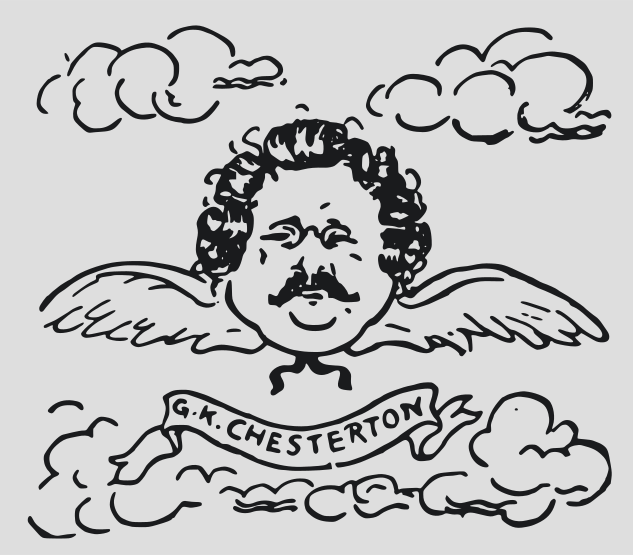
Drawing of G.K. Chesterton made by Karel Čapek following his visit to Britain.
Then, in the middle of the debate, members of the audience spotted Irish socialist Bernard Shaw in the theatre. They shouted for him to take part until he eventually climbed onto the stage and delivered, impromptu, what the Daily Chronicle called “one of the best speeches it had probably been their lot to hear.” Shaw made the argument that we are made into robots by propaganda and work, claiming that “if it has to be, I would like to be robot for two hours a day in order to be Bernard Shaw the rest of the day.” 11
Reports of this debate reached Čapek, who was at last confronted by the effects of his play, mutated enough that it perhaps felt as foreign to him as the audiences to whom it had been performed. His response, which was published in The Saturday Review, reveals what his intentions for the play were and the accuracy of our speculation12.
The Saturday Review
21 July 1923
The Meaning of R.U.R.
I have just learnt of the discussion about the meaning of a play which, for certain serious reasons, I lay claim to as my own. Authors are reputed to be childishly vain, and as one of them I claim the privilege of saying a few words on behalf of my work.I enjoyed very much the creeds and ideals of Mr. Chesterton, as well as those of Mr. Shaw and Commander Kenworthy. But it seems to me that, so far as my play was concerned, their chief interest was centred upon Robots. For myself, I confess that as the author I was much more interested in men than in Robots.
I wished to write a comedy, partly of science, partly of truth. The old inventor, Mr. Rossum, is no more or less than a typical representative of the scientific materialism of the last century. His desire to create an artificial man in the chemical and biological, not the mechanical sense, is inspired by a foolish and obstinate wish to prove God to be unnecessary and absurd. Young Rossum is the modern scientist, untroubled by meta-physical ideas; scientific experiment is to him the road to industrial production, he is not concerned to prove, but to manufacture.
We are in the grip of industrialism; this terrible machinery must not stop, for if it does it would destroy the lives of thousands. It must, on the contrary, go on faster and faster, although it destroy in the process thousands and thousands of other existences. Those who think to master the industry are themselves mastered by it; Robots must be produced although they are, or rather because they are, a war industry. The conception of the human brain has at last escaped from the control of human hands. This is the comedy of science.
Now for my other idea, the comedy of truth. The General Manager Domin, in the play, proves that technical progress emancipates man from hard manual labour, and he is quite right. The Tolstoyan Alquist, on the contrary, believes that technical progress demoralizes him, and I think he is right, too. Bussman thinks that industrialism alone is capable of supplying modern needs; he is right. Helena is instinctively afraid of all this inhuman machinery, and she is profoundly right. Finally, the Robots themselves revolt against all these idealists, and, as it appears, they are right, too.
Each and every one of them has the deepest reasons, material and mental, for his beliefs, and according to his lights seeks the greatest happiness for the greatest possible number of his fellow-men. I ask whether it is not possible to see in the present social conflict of the world an analogous struggle between two, three, five, equally serious verities and equally generous idealisms? I think it is possible, and this is the most dramatic element in modern civilization, that a human truth is opposed to another truth no less human, ideal against ideal, positive worth against worth no less positive, instead of the struggle being, as we are so often told it is, one between noble truth and vile selfish error.
These are the things I should like to have said in my comedy of truth, but it seems that I failed, for none of the distinguished speakers who took part in the discussion have discovered this simple tendency in R.U.R.
What we find in this response is an artist disappointed by his inability to communicate nuance, and that is not a rare thing. What is rarer is how this play succeeded in spite of that.
Drama’s most fundamental unit is the collision of two wills. Čapek, in reaching for a comedy of truth, tried to subvert this by telling a story of parallels with no clear protagonist or villain. It was a monumental task, and, by his own admission, he failed. To dramatise a society of equally valid truths, he had to first take the society apart and lay its arguments out like specimens. Each character has a fixed position, each correct on its own terms without contradiction or eccentricity — this is not human. To me, this is the very same logic that produced the robot, the distillation of nature into something optimal yet empty. This is a play about ideologies, not people. And in writing it Čapek betrayed himself by unconsciously revealing a disinterest in, or perhaps a blindness to, the inner life of those who he seeks to critique. It is a cynical worldview that sits deeply at odds with the political analysis he claims to have intended.
But none of this matters.
Audiences didn’t come to the theatre for Čapek’s political insights but for his robots. And although this may have been enough for them, it was not enough for him. He had wanted to say something complicated and profound. Rather than critique the world, he wished to succeed at the harder task of showing us a world worth saving. Because Čapek, at least, knew such a world existed and I think his inability to communicate that injured him. But I wonder if he succeeded at doing something else, a stranger task that he didn’t fully appreciate.
The imaginative genius of the robots cannot be overstated. In a story itself worthy of a stage, after rebelling against their masters the robots defied fate by defeating Čapek himself. In fact, so complete was their victory that they escaped the play entirely and took over the world by embedding themselves in almost every major language as a loanword. Regardless of what you thought about the play, whether you were convinced by the story or not, you left the theatre carrying a little robot in your mind. Although we’ve had our suspicions, so far we’ve only seen robots from the outside. Their origin remains a mystery, the answer to which lies within the imagination of Karel Čapek himself, a man distant and dead. And this is where we shall travel next. To a place that every robot must call home, the life of the man who created them. This is the final leg of our journey before we can return to modern times, now forever changed by a play written for a country that no longer exists.
References
- P. Tacikowski et al., “Human hippocampal and entorhinal neurons encode the temporal structure of experience," Nature, vol. 635, pp. 160–167 (2024)
- Andreas Teichgräber, & John Van Reenen, (2021). Have productivity and pay decoupled in the UK? International Productivity Monitor, 41, 31–60.
- Byung-Chul Han, The Burnout Society, trans. Erik Butler (Stanford: Stanford University Press, 2015). Originally published as Müdigkeitsgesellschaft (Berlin: Matthes & Seitz, 2010)
- Karel Čapek, R.U.R. (Rossum’s Universal Robots), 1920. English translation by Paul Selver, adapted by Nigel Playfair. Project Gutenberg
- “R.U.R. at St Martin’s Theatre,” Illustrated London News, 1923
- Tobias Higbie, “Why Do Robots Rebel? The Labor History of a Cultural Icon," Labor: Studies in Working-Class History of the Americas (2013)
- John Corbin, review of R.U.R., New York Times, 1922; Basil Dean, telegram to the Lord Chamberlain’s Office, 17 April 1923; quoted in Reilly (2011), pp. 171–173
- Review of R.U.R., Manchester Guardian, 1923; quoted in Reilly (2011), p. 176
- Lord Chamberlain’s Examiner’s report on R.U.R., 1923; quoted in Reilly (2011), pp. 171–173
- Ondřej Pilný, “The Brothers Čapek at the Gate: R.U.R. and The Insect Play," in Cultural Convergence: The Dublin Gate Theatre, 1928–1960 (Palgrave Macmillan, 2021)
- Hubert Griffith, “A New Debating Club,” London Daily Chronicle, 28 June 1923; see also “R.U.R.” (report on the Playbox Debate), 22 June 1923
- Karel Čapek, “The Meaning of R.U.R.,” Saturday Review, vol. 136, 21 July 1923, p. 79
- Kara Reilly, “From Automata to Automation: The Birth of the Robot in R.U.R.,” in Automata and Mimesis on the Stage of Theatre History (Palgrave Macmillan, 2011)